
Meta description: Learn how to create a content marketing strategy that drives organic traffic, builds authority, and improves your search engine rankings.
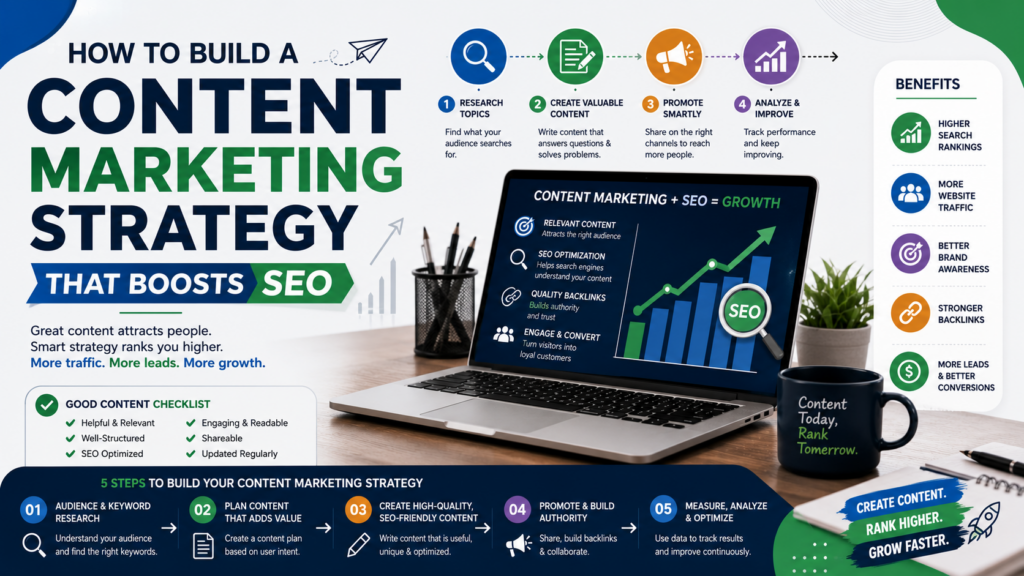
If SEO is the engine that drives organic traffic, content is the fuel. You can have a technically perfect website, but without valuable, well-optimized content, there’s little for search engines or people to find you for.
This post walks through how to build a content marketing strategy specifically designed to strengthen your SEO and turn your website into a long-term traffic asset.
Why Content and SEO Go Hand in Hand
Search engines exist to serve the most relevant, helpful answer to a searcher’s query. The more high-quality content you publish around topics your audience cares about, the more opportunities you create to rank and the more authority your site builds in your niche over time.
Content also fuels the rest of your SEO efforts: it earns backlinks, keeps visitors on your site longer, and gives you material to share across email and social channels.
Step 1: Understand Your Audience’s Questions
Great content starts with understanding what your audience is actually searching for. Look at:
- Customer questions What do people ask you directly, in emails, calls, or reviews?
- “People also ask” boxes on Google for your core topics.
- Keyword research tools to find related searches and question-based queries.
The goal is to build a list of real questions and problems your content can solve.
Step 2: Map Content to the Buyer’s Journey
Not all content serves the same purpose. Structure your content around three stages:
- Awareness stage: Educational blog posts and guides that address a problem (e.g., “What is X?” or “Signs you need Y”).
- Consideration stage: Comparison posts, case studies, and how-to content that help readers evaluate solutions.
- Decision stage: Product pages, testimonials, and detailed FAQs that help convert a ready-to-buy visitor.
Mapping content this way ensures you’re not only attracting traffic but guiding visitors toward becoming customers.
Step 3: Prioritize Topic Clusters Over Random Posts
Rather than publishing disconnected blog posts, organize your content around topic clusters:
- A pillar page covers a broad topic comprehensively.
- Several cluster posts dive deeper into subtopics and link back to the pillar page.
This structure signals topical authority to search engines and makes it easy for readers to navigate related content — both of which support stronger rankings.
Step 4: Write for Readers First, Search Engines Second
The strongest-performing content today is genuinely useful, well-researched, and easy to read — not stuffed with keywords. Focus on:
- Clear, scannable formatting with headers and short paragraphs.
- Real examples, data, or first-hand insight rather than generic filler.
- A natural writing style that answers the query thoroughly.
Search engines have gotten very good at rewarding content that satisfies the reader — write for them first, and the optimization will follow naturally.
Step 5: Repurpose and Extend Content
Every piece of content can work harder than a single blog post. Consider repurposing into:
- Social media snippets and carousels
- Email newsletter features
- Short videos or infographics
- Updated versions as the topic evolves
This extends your content’s reach without starting from scratch each time and each new touchpoint can drive traffic back to the original page.
Step 6: Keep Content Fresh
Search engines favor content that stays accurate and current. Set a regular schedule to:
- Update statistics, examples, and outdated information.
- Refresh underperforming pages with better formatting or expanded detail.
- Remove or consolidate thin, low-value pages that dilute your site’s overall quality.
Measuring Content Success
Track content performance using metrics like:
- Organic traffic to each page over time
- Average time on page and bounce rate
- Keyword rankings for target terms
- Conversions generated from content pages
Use these insights to double down on what’s working and revise what isn’t.
Final Thoughts
A strong content marketing strategy isn’t about publishing constantly it’s about publishing deliberately, with each piece serving a clear purpose in your audience’s journey and your overall SEO goals. Start with topics your audience is genuinely asking about, organize them into clusters, and keep refining based on performance data.
Not sure where to start? Pick your three most common customer questions and turn each into a well-optimized blog post that’s often the fastest way to see SEO traction.