
Meta description: A practical guide to link building why backlinks matter for SEO, which types of links carry the most value, and proven strategies to earn them.
Great content and a technically sound website will only take your SEO so far. To truly compete for top rankings, search engines need signals that other reputable sites vouch for yours and that’s exactly what backlinks provide. Link building remains one of the most impactful, and most misunderstood, parts of SEO.
This guide covers what link building actually is, why it matters, and practical strategies to earn links that move the needle.
What Is Link Building?
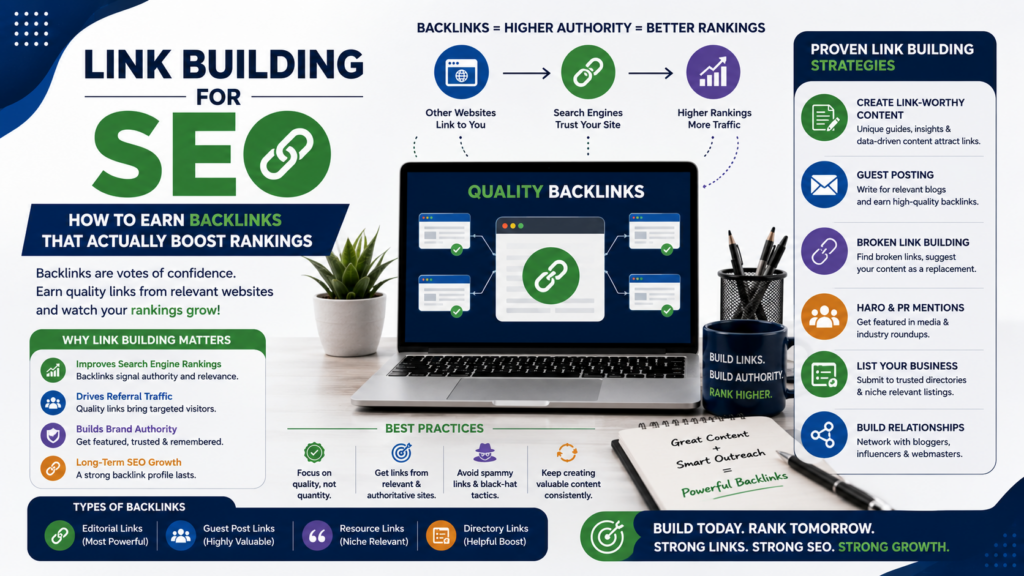
Link building is the process of getting other websites to link back to pages on your site. Each backlink acts like a vote of confidence the more high-quality, relevant sites that link to you, the more search engines trust that your content is valuable and authoritative.
Not all links are equal, though. A single link from a respected, relevant industry site can be worth far more than dozens of links from low-quality or unrelated websites.
Why Backlinks Matter for SEO
- Authority signals: Backlinks remain one of the strongest ranking factors search engines use to evaluate trustworthiness.
- Referral traffic: Beyond rankings, links from relevant sites can send direct, qualified visitors to your site.
- Faster indexing: Search engines discover new pages more quickly when they’re linked from sites that are already being crawled regularly.
- Competitive edge: In competitive niches, a stronger backlink profile is often what separates page one from page two.
What Makes a Backlink Valuable
When evaluating link opportunities, consider:
- Relevance: A link from a site in your industry or niche carries more weight than one from an unrelated site.
- Authority: Links from well-established, trusted domains pass more value than links from brand-new or low-quality sites.
- Placement: A link within the body of relevant content is generally more valuable than one buried in a footer or sidebar.
- Anchor text: The clickable text of the link should read naturally and give context about the linked page, without being overly keyword-stuffed.
Effective Link Building Strategies
1. Create Genuinely Link-Worthy Content
The foundation of sustainable link building is content people actually want to reference original research, data studies, in-depth guides, or useful tools. Content that provides unique value naturally attracts links over time.
2. Guest Posting
Writing valuable articles for other reputable sites in your industry, with a natural link back to your own content, remains an effective way to earn relevant backlinks while also reaching a new audience.
3. Build Relationships, Not Just Links
Reach out to other site owners, bloggers, and journalists in your niche not with a generic link request, but by genuinely engaging with their content, offering value, and building a real relationship first. Links earned through relationships tend to be higher quality and more sustainable.
4. Fix Broken Link Opportunities
Find broken links on relevant websites pointing to content similar to yours, and suggest your own page as a replacement. This approach helps the site owner fix a problem while earning you a relevant, contextual link.
5. Get Listed in Industry Directories
Reputable, niche-specific directories and associations related to your industry can be a legitimate source of relevant backlinks, particularly for local or specialized businesses.
6. Digital PR and Newsworthy Content
Creating original research, surveys, or noteworthy data that journalists and bloggers want to cite can earn high-authority links at scale, especially when paired with proactive outreach to relevant media.
7. Reclaim Unlinked Mentions
Sometimes other sites mention your brand without linking to you. Monitoring for these mentions and reaching out to request a link is a quick, often overlooked way to convert existing visibility into SEO value.
Link Building Practices to Avoid
- Buying links Paid link schemes violate search engine guidelines and can result in penalties.
- Link farms and low-quality directories Mass submissions to spammy, unrelated directories provide little to no SEO value and can harm your credibility.
- Excessive reciprocal linking Trading links purely for SEO benefit, without genuine relevance, is a red flag to search engines.
- Over-optimized anchor text Repeating exact-match keyword anchor text unnaturally across many links can look manipulative.
Measuring Your Link Building Progress
Track your backlink profile over time using tools that show:
- Total referring domains (unique websites linking to you)
- The authority or trust score of linking domains
- New and lost links over time
- Anchor text distribution
Focus on steady, sustainable growth in quality referring domains rather than chasing link volume alone.
Final Thoughts
Link building isn’t about accumulating as many backlinks as possible it’s about earning links from relevant, credible sources that genuinely reinforce your site’s authority. Start by creating content worth linking to, then build genuine relationships and outreach around it. Sustainable link building takes time, but it compounds into one of the strongest long-term SEO advantages your site can have.
A good starting point: identify your best-performing piece of content and think about three types of sites that would genuinely benefit from linking to it then reach out.